
The answer: phycocyanin.
A natural fluorescent blue pigment, and it comes from one of the oldest foods on earth:
spirulina.
The answer is spirulina. The better question is which one.
The blue-green algae NASA studied as astronaut food. Most people have never had the real thing.
The answer is spirulina.
500 years ago, the Aztecs harvested it from a lake and ate it for its combination of protein and iron. Most people today have never had the real thing.
The answer is spirulina.
Its family made the oxygen you’re breathing, and it still carries 500 mg of a rare blue antioxidant pigment in every serving of Rise.
The answer is spirulina.
The Kanembu people of Chad call it dihé and have eaten it for hundreds of years. Kanembu women still harvest it by hand.
Atriva Rise prints 500mg of phycocyanin, the blue in spirulina, on every serving.
Every batch gets a lab report, posted for you to read.
If you came here wondering what it was, this is it. Spirulina. One of the oldest foods on earth, and one almost nobody eats. Keep reading, because the version most people picture and the version worth taking are not the same thing.
So what is it, actually?
Spirulina is a blue-green algae. It comes from a family of organisms that’s been on earth for about 3.5 billion years, older than plants and older than the dinosaurs. It grows in water, gets dried, and that’s basically the whole process. It isn’t made in a lab. It’s a whole food, and it’s about 60 to 70% protein.
That’s why NASA studied it as food for astronauts on long missions. When every gram you carry into space has to earn its place, a whole food that grows in a tank and is mostly protein gets a long look.
But not all spirulina is the same.
Once people get interested in spirulina, they grab the cheapest tub on the shelf and assume it’s all the same. It isn’t. Two bottles can look identical and give you completely different things, and the label is the only place you’d ever find out.
The trouble is most labels don’t make it easy. They’ll say “high quality” or “pure,” and leave out the numbers that would actually let you check. If it’s not on the label, you can’t know what you’re getting.
That’s the whole reason Atriva Rise exists.
Two numbers tell you what you’re actually getting.
The first number: grams.
Most spirulina bottles put the tablet count right on the front and tell you how many to take a day. The number that tells you how much spirulina you’re actually getting is the grams per serving, and it’s usually on the back, in the Supplement Facts. Two bottles can both say 120 tablets and both say four a day, and still deliver completely different amounts, because the tablets aren’t the same size. Four small tablets can come to 2 grams. Four bigger ones can come to 4. Atriva Rise is 4 grams of whole spirulina per serving, four tablets. Same count most bottles have, with twice the spirulina some of them give you.
The second number, and the one that matters most: phycocyanin.
Grams tell you how much spirulina you’re getting. Phycocyanin tells you how much of the part that counts is in it. Phycocyanin is the blue in spirulina, it’s the piece people pay the most attention to, and not all spirulina carries the same amount. Atriva Rise puts it right on the front: 500 mg of phycocyanin in every serving. Atriva Rise contains phycocyanin, a natural pigment with antioxidant properties.† So there are really two numbers to check on any spirulina: the grams per serving, and the phycocyanin inside them. Plenty of bottles bury the first and leave the second off the front entirely.
Here’s what’s rare: you can prove both.
Printing a number is easy. Anyone can print a number. Almost no one lets you prove it. Every batch of Atriva Rise gets an independent lab report you read by lot, so the grams and the 500 mg aren’t numbers we’re asking you to take on faith. They’re numbers you can check against the test for your own bottle. Batch 1 is still being made right now, and as a founding member you’ll see that first report before your bottle ships. Don’t trust. Verify.
Whole spirulina, not an extract.
Atriva Rise is whole spirulina pressed into a simple tablet, four tablets to a full serving. Because it’s the whole food and not an extract, you get what spirulina naturally carries, including iron. Atriva Rise provides iron, which supports normal energy metabolism, for natural daily energy.† A serving has 4 mg, 22% of the Daily Value.
Get in before Batch 1.
Right now there’s no buy button, just a founding list. Batch 1 is small, and it goes to this list first, before the public and before the ads. You’ll see the first lab report before your bottle ships, and your first order is covered by a 60-day guarantee. Try it for at least 30 days. If it’s not for you, email us before day 60 and we’ll refund you. You keep your first bottle, no return needed.
Join the founding list →Pair it with Atriva Rest.
Atriva Rise is built for the start of your day. Atriva Rest is built for the end of it: magnesium glycinate, 290 mg of elemental magnesium a serving, in a clear capsule you can see through. Same rule behind both. The real number on the label, and a lab report for every batch.
Both are in Batch 1.
See Rise + Rest →3.5 Billion Years Old. One Ingredient.No Blends. No Lies. No More.
Ancient civilizations built empires on it. People have studied it ever since. Most people have still never heard of it.
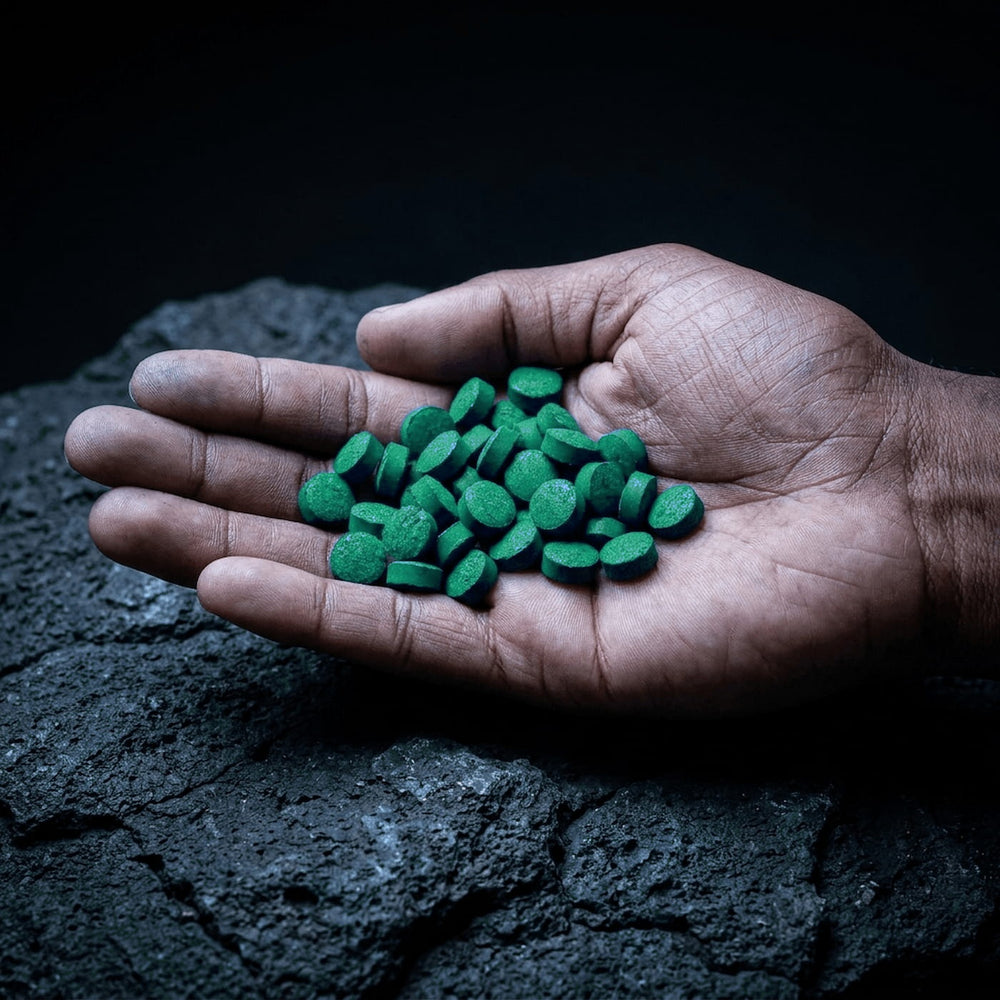
Join the founding list.
Batch 1 is small. Get first access and see the lab report first.
Count the bottles in your supplement cabinet right now.
For most people it’s somewhere between 5 and 12. A multivitamin. A probiotic. Fish oil. Collagen. Something for energy. Something for inflammation. Something because a podcast told them to.
That cabinet can run you $150 to $300 a month. Your confidence that any of it is working: zero.
Now imagine starting with one ingredient. One you can read on the label and check in a lab report.
It is 3.5 billion years old. Not million. Billion.
It was here before the first plant. Before the first tree. Before there was breathable air on this planet. It helped create the oxygen.
Its family, cyanobacteria, has been on Earth for billions of years and came through every mass extinction.
And it’s still here. You just can’t see it.
It isn’t a plant. It’s a microscopic spiral of living strands, so small you’d need a microscope to see a single one.
It grows wild in warm, salty lakes so alkaline that almost nothing else can survive in them. In Kenya, flocks of flamingos live on it.
It feeds on sunlight. And it turns that sunlight into something remarkable:
it’s 60 to 70% protein by dry weight, and full of chlorophyll.
But it carries something most foods don’t.
A natural fluorescent blue pigment with antioxidant properties.†
That pigment is called phycocyanin, and you’ll barely find it anywhere else in the food supply.
It’s what makes this organism what it is.
Its name is spirulina.
And phycocyanin is part of how spirulina helps support your body’s defenses against oxidative stress.†
This isn’t a trendy superfood. This is something that was here billions of years before the word “superfood” existed.
The Kanembu People of Chad

On the shores of Lake Chad, the Kanembu people independently discovered the same organism. They called it Dihé. Women harvested it using woven baskets, dried it in shallow sand filters, and cooked it into a savory sauce served over millet.
When European scientists arrived in the 1960s, they were stunned. Early accounts described the Kanembu as well nourished despite living in one of the harshest climates on earth.
Their daily dihé supplied amino acids and iron.
The Aztec Empire — The Runners’ Fuel

Over 600 years ago, the Aztecs harvested spirulina from Lake Texcoco in present-day Mexico. They called it Tecuitlatl. They scooped it from the water with fine-mesh nets, sun-dried it into dense cakes, and sold it across all social classes in the great market of Tenochtitlan.
But the most famous use was by the empire’s marathon couriers. These runners traveled hundreds of kilometers carrying fresh fish from the Gulf of Mexico to Emperor Montezuma’s table. Their fuel for the journey? Dried spirulina cakes. Lightweight. Calorie-dense. Packed with complete protein and iron. The original performance supplement — centuries before protein bars.
That’s because it’s 60 to 70% protein by dry weight, with iron. Spirulina was one of the key protein sources for Tenochtitlan, the Aztec capital.
Two civilizations. Two continents.
Zero contact with each other. Both independently built their survival around the same organism.
The Aztecs didn’t have lab analysis.
The Kanembu didn’t have clinical trials.
Here’s what four tablets a day give you, in plain terms:
- ✓Antioxidant defense — phycocyanin, a natural pigment with antioxidant properties, helps support the body’s defenses against oxidative stress
- ✓Energy — provides iron, which supports normal energy metabolism. No caffeine or stimulants.
- ✓Oxygen — provides iron, which helps carry oxygen through your body.
- ✓Immune function — provides iron, which supports normal immune function.
Zero stimulants.
Here’s the part most people miss.
Most supplements are isolated compounds —
one nutrient, made to do one job.
Spirulina is different. Not because it’s magic. Because it’s a whole food: dozens of compounds that grow together in one organism.
That’s why we sell it whole, with no added extract.
The supplement cabinet isn’t the solution.
It’s the symptom of not having a foundation.
Here’s what’s printed on our label for every serving:
Protein is about 2.8g, rounded to 3g on the label as FDA rules require.
And that deep blue-green color? That’s chlorophyll and phycocyanin together.
Phycocyanin is a natural pigment with antioxidant properties. Spirulina helps support your body’s defenses against oxidative stress.†
We guarantee at least 500mg in every serving and print it on the label.
In whole spirulina, it comes built in. Naturally. The way it’s existed for 3.5 billion years.

Caffeine borrows alertness from tonight and gives it to you now. That’s not a solution. That’s a loan with interest.
Atriva Rise has no caffeine and no stimulants.
It provides iron, which supports normal energy metabolism.†
Here’s what to check.
The supplement industry’s best customer is the one who never reads the label.
Don’t be that customer.
Five questions. If the brand can’t answer all five, walk away.
- ✓Does it tell you the exact dose on the label? — check the grams per serving.
- ✓Does it declare phycocyanin content? — a guaranteed minimum per serving. Tested and printed. Not “contains antioxidants.”
- ✓Can you trace the source? — what farm? What country? “Premium quality” is not an answer.
- ✓Can you see the batch test? — the actual Certificate of Analysis. Heavy metals. Microcystins. Microbiology. For THIS bottle.
- ✓Is the label clean? — spirulina, and anything else listed plainly. No stimulants. No blends. No padded panel.
That’s the bar. Run any brand through it.
which spirulina, at what dose, from what source, and can you see the test.
Atriva Rise ships with Batch 1.
Individual results may vary.